We have a lot of choices of what to watch.
I remember when I was younger (wow, I sound old). There were four channels: ABC, NBC, CBS, and KQED. Turning to any of the other channels on the dial (that we had to turn to change channels) would only elicit a fuzzy snow, accompanied by an inexplicable hissing noise.
We now have hundreds, HUNDREDS! of channels from which to choose.
And I have some recommendations as to what you should, and should not, watch.
Watch awards shows, but only pay attention when people who win seem genuinely, truly surprised that they won. If you sense actual humility, pay attention. It's lovely. Heartwarming. It will bring a tear to your eye.
Watch the very last story on the national news. It's always about someone who has done something wonderful for someone else. It's never, ever about politics.
Watch BBC television. Specifically cop/mystery shows. The Brits are not afraid to kill off main characters without a second thought. The writing is top notch, the actors are fantastic but largely unknown (to us), and the stories are thought-provoking and intriguing. You will not find CSI London on BBC TV. The Brits are also not opposed to a limited story. If all they have is a spectacular one or two-season arc, they will end it after one or two seasons, future profits be damned. Marcella, Dr. Foster, The Five as examples.
Also watch BBC comedies. Anything by Phoebe-Waller Bridge should be must-see TV if you appreciate brilliant, ground-breaking writing. Additional bonus: I have yet to hear a laugh-track on any British-born show. Ever. They don't need one. What's funny is funny. You shouldn't have to be nudged to laugh.
Conversely, here's what you probably should not watch: anything you fondly remember from your youth. The Brady Bunch does not hold up. It breaks my heart to say that. And don't think that me saying that means I won't watch it. I absolutely will. But it does not hold up and I'm always just a teeny bit ashamed of myself after I watch it. Along the same lines, don't revisit The Love Boat, Dallas, Melrose Place, Family Ties, The Cosby Show (for so, so many reasons), or The Facts of Life. Just don't. You'll be so disappointed that the people who filled your youth were in fact such awful, terrible over-actors. Do not rewatch any ABC After School Special. Kristy McNichol was not all she was cracked up to be. And Rick Springfield was WAAAAY too old to be in one of those, by the way, and we all knew it.
I think perhaps the exception to the rule of what NOT to revisit might be cartoons. Bug Bunny never gets old. Morocco Mole and Secret Squirrel will still make you smile. You'll sing along with the Speed Racer theme song (Go Speed Racer, Go!) and you'll still want to be Trixie or Racer X. No matter how hard you try, you will not be able to figure out why six-year-old Spritle had a pet chimpanzee and why your parents would not consider getting you one.
And as you reminisce, you'll be amazed at the constructs of some of your most beloved childhood cartoons, and wonder how anyone came up with the ideas for them in the first place. A few examples:
1. A penguin and a walrus are problem-solving together. When they can't figure something out, they consult a human being, Professor Whoopee, who usually has to search an overstuffed closet, the contents of which always fall out when he opens the door, for some prop to help him explain the answer.
Who pitched that idea? More importantly, who listened to the pitch and thought, "Wow, that's a GREAT idea!" I mean, it actually was a great idea, but who actually recognized that it was a great idea? I know I wouldn't have if I were a TV exec in the 1960's.
2. A pop group consisting of four anthropomorphic animals (Bingo, Fleegle, Drooper and Snorky) host a variety of cartoons, songs and skits.
I took that right off of Wikipedia. Bonus points to you if you can sing the entire theme song.
Sorry. That'll eat at you all day until you finally google it.
3. H.R. Pufnstuf is the story of Jimmy, a boy with a talking golden flute, whose adventure begins when he climbs into an abandoned sailboat on the shore of a lake. But it is Witchiepoo’s trick to capture the boy to get his magic flute. He and the flute are rescued by a kindly dragon named H.R. Pufnstuf on Living Island where almost everything talks. All would be happy, – what with dancing trees, singing frogs and a lollipop that owns a candy store– if it wasn’t for that mean ol’ Witchiepoo who keeps coming after the flute.
Honestly, while I can, in fact, sing you the entire theme song from HR Puffnstuf, I would not have remembered any of the actual plot. But now that I am reminded of Jimmy and the golden flute, I can hear the voice of the flute in my head--quite annoying and high-pitched as I recall. But probably not something that bothered me when I was four.
I was thinking that, again, this is just a weird pitch to make for a children's show but now that I'm re-reading it, it sounds suspiciously close to the Wizard of Oz. Did Sid and Marty Kroft ever get sued?
I got a little off on a tangent there, sorry. And I'm realizing that there's no reason why I should be recommending what you watch or don't watch on television. We each like what we like. What entertains me might horrify you (I will watch anything with Timothy Olyphant, even if he kills copious numbers of people violently). What thrills you might bore me (never, ever going to watch any iteration of The Bachelor).
I'm going to finish this off with a recommendation, even though I just said there's no reason I should be doing this. But I'm doubling down on my very first suggestion in this post.
The Golden Globes are this weekend. (Don't watch the red carpet crap. People are mean.)
But watch the acceptance speeches. This is the first awards show of the season (I think) and some of the people who win will be genuinely surprised and give rambling, funny, humble, grateful acceptance speeches.
Watch that.
It never gets old. And it always holds up.
Thursday, January 2, 2020

Wednesday, January 1, 2020
Grandpa's Mystery Box
This is an old 8mm film projector. I do not have one of these, though I do remember the one my dad used to set up on our dining room table, with the projection aimed onto the sliding kitchen door, to show us home movies. Good stuff. I also do not have any old home movies.
 What I do have are six (SIX!) metal canisters that once held home movies. So to recap--I have neither a projector nor any actual movies. Just empty canisters.
These canisters have sat in my cupboard for years now, untouched. Shocker, I know. In my mind, when I saw them, I thought they might make clever gift boxing. I don't know why I thought that. They are round, about 1/2 an inch thick with a diameter of about six inches. What on earth did I think was going to fit into one of these canisters? I have no idea.
It's my fault that I have these useless items. Several years ago, I raised my hand in response to a question, asked by my dad, during the annual Rathjen Christmas tradition known as "The Mystery Box"**: Did anyone want the film canisters? And up went my hand, much to my husband's chagrin, and antithetical to every word Dave has ever uttered to me regarding responding to my dad's proclivity toward unloading sentimental (mostly to my dad), useless (for the most part) items dredged up from the depths of ... everywhere. Literally. From closets. From the garbage garage. From storage. From boxes. From bookshelves. From desks. From file cabinets.
The Mystery Box: I actually find the whole concept endearing. So here it is, all laid out.
This is the box. Nothing fancy going on here. I think he's used the same box for the past six or seven years.

My dad gathers items throughout the year into this box. These items run soup to nuts (literally--you could find expired cans of soup in the box, though they would likely be from an old MRI from my dad's army days--you think I'm kidding but I'm not). The box has contained, over the years, among other things: old drivers' licenses, expired passports, plastic plates from when my brothers and I were still eating in highchairs, fifty-five year old artifacts from Liberia and Turkey, books in Russian and German, old physics-themed t-shirts from my dad's teaching days, a Turkish bong (what were my parents DOING in Turkey?), a scalpel (again, not kidding), a serving tray, drawings made by my dad during the war when he was six years old (quite the impressive artist, he was able to draw very convincing battle scenes as well as swastikas), a hand drill, an inlaid music box, authentic Russian military pins (these just add to the myth of my dad at one point being a CIA operative), a George Washington picture, a patriotic pencil holder, small metal animal figures... the list goes on. In fact, as my nephew reminded me, there is an actual list of what goes into the box each year that my dad maintains on a spreadsheet.
Retirement brings lots of imaginative ways to occupy your time.
Anyway, on Rathjen Christmas, after stockings have been opened, my dad makes the anticipated entrance into the room and talks a little bit about what's in the box (WHAT'S IN THE BOX?!?!--that was just for Olivia and Dave). He always tells us that no one has to take anything if they don't want to, and he also always lets us know that if we find something that we think is better suited to someone else, or we want something that someone else has, we can always trade. And we can take as much as we want.
It is at this point that (my) Dave and Jill always give each other knowing looks, silently communicating their solidarity in not wanting anything from this box to make its way into their homes. The picture below is a candid. This really happens. I'm not making it up.

Kids (and some adults) then get up and rifle through the box. It used to be that everyone would, one at a time (and some under duress) reach in without looking and pull something out, but it has evolved into whoever wants to just gets up and looks into the box to explore its contents, claiming anything of interest.
This year my dad outdid himself. He putt into the box a book that he and my mom tried (and I emphasize the word tried, because in no way did they succeed) to read to us kids when we were younger. The book is called Where Did I Come From and it covers exactly what you think, but not likely in the way you are imagining. Below is a sampling of the mild hysteria that ensued as grandkids attempted a read-aloud.


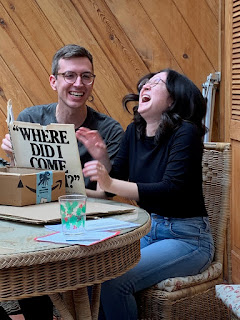
Nobody likely ended up taking this book home. That is not an indication of any sort of failure on anyone's part. Because it's not about what's in the box and whether anyone wants any of it. I mean it is a little bit. But not really. It's more about what happens when the box is opened. It's about the anticipation and the reactions. And the stories and the laughter. And the discussions and the interactions. And the memories and the tradition.
The whole Mystery Box is a living metaphor. It's as if we reach into my dad's brain and pull out a detail for him to reveal or a story for him to tell. It's an amazingly creative way for him to share his past (or at least what the CIA will let him divulge).
And that is the real magic of the Mystery Box.
** It turns out that different family members have different names for the Mystery Box tradition. Below is a sampling of responses I received when I asked what everyone calls it:
Me: Grandpa's Surprise Box
Dave: Grandpa's Box of Shit
Olivia: Mystery Grab Box
Mark: Mystery Box
Steven: Grab Bag
Jill: the Crap Box
Emma: the Box

These canisters have sat in my cupboard for years now, untouched. Shocker, I know. In my mind, when I saw them, I thought they might make clever gift boxing. I don't know why I thought that. They are round, about 1/2 an inch thick with a diameter of about six inches. What on earth did I think was going to fit into one of these canisters? I have no idea.
The Mystery Box: I actually find the whole concept endearing. So here it is, all laid out.
This is the box. Nothing fancy going on here. I think he's used the same box for the past six or seven years.

My dad gathers items throughout the year into this box. These items run soup to nuts (literally--you could find expired cans of soup in the box, though they would likely be from an old MRI from my dad's army days--you think I'm kidding but I'm not). The box has contained, over the years, among other things: old drivers' licenses, expired passports, plastic plates from when my brothers and I were still eating in highchairs, fifty-five year old artifacts from Liberia and Turkey, books in Russian and German, old physics-themed t-shirts from my dad's teaching days, a Turkish bong (what were my parents DOING in Turkey?), a scalpel (again, not kidding), a serving tray, drawings made by my dad during the war when he was six years old (quite the impressive artist, he was able to draw very convincing battle scenes as well as swastikas), a hand drill, an inlaid music box, authentic Russian military pins (these just add to the myth of my dad at one point being a CIA operative), a George Washington picture, a patriotic pencil holder, small metal animal figures... the list goes on. In fact, as my nephew reminded me, there is an actual list of what goes into the box each year that my dad maintains on a spreadsheet.
Retirement brings lots of imaginative ways to occupy your time.
Anyway, on Rathjen Christmas, after stockings have been opened, my dad makes the anticipated entrance into the room and talks a little bit about what's in the box (WHAT'S IN THE BOX?!?!--that was just for Olivia and Dave). He always tells us that no one has to take anything if they don't want to, and he also always lets us know that if we find something that we think is better suited to someone else, or we want something that someone else has, we can always trade. And we can take as much as we want.
It is at this point that (my) Dave and Jill always give each other knowing looks, silently communicating their solidarity in not wanting anything from this box to make its way into their homes. The picture below is a candid. This really happens. I'm not making it up.

Kids (and some adults) then get up and rifle through the box. It used to be that everyone would, one at a time (and some under duress) reach in without looking and pull something out, but it has evolved into whoever wants to just gets up and looks into the box to explore its contents, claiming anything of interest.
This year my dad outdid himself. He putt into the box a book that he and my mom tried (and I emphasize the word tried, because in no way did they succeed) to read to us kids when we were younger. The book is called Where Did I Come From and it covers exactly what you think, but not likely in the way you are imagining. Below is a sampling of the mild hysteria that ensued as grandkids attempted a read-aloud.


Nobody likely ended up taking this book home. That is not an indication of any sort of failure on anyone's part. Because it's not about what's in the box and whether anyone wants any of it. I mean it is a little bit. But not really. It's more about what happens when the box is opened. It's about the anticipation and the reactions. And the stories and the laughter. And the discussions and the interactions. And the memories and the tradition.
The whole Mystery Box is a living metaphor. It's as if we reach into my dad's brain and pull out a detail for him to reveal or a story for him to tell. It's an amazingly creative way for him to share his past (or at least what the CIA will let him divulge).
And that is the real magic of the Mystery Box.
** It turns out that different family members have different names for the Mystery Box tradition. Below is a sampling of responses I received when I asked what everyone calls it:
Me: Grandpa's Surprise Box
Dave: Grandpa's Box of Shit
Olivia: Mystery Grab Box
Mark: Mystery Box
Steven: Grab Bag
Jill: the Crap Box
Emma: the Box
Thursday, December 26, 2019
Words I Cannot Use
A little more of my crazy for you. So you can get a little peek into my brain.
It's a wild ride in there.
The following are words with which I cannot bring myself to have any sort of voluntary contact.
Doesn't mean I have no contact with them. Turns out it's unavoidable at times.
But this does explain why I sometimes stop watching really, really great tv shows smack in the middle of season 3 (out of 6), or why I abandon books I have heard are great, and occasionally why I seemingly rudely leave conversations in social situations.
So here we go.
1. Journey: I literally (and I am using that word correctly here) cannot stand the word "journey". Many blog posts ago I alluded to the fact that I do not understand why anyone would refer to their medical crisis as a "cancer journey". It's not like it's a vacation. Or a trip. You're not fulfilling your lifelong dream to go somewhere. But it is quite the popular phrase among patients in the oncology world. Now, several years into this whole situation, I cannot bring myself to even use the word journey as a reference to an actual adventure. I just don't use the word. At all. Ever. Too much baggage associated with it (for me). If you happen to ask me where I am journeying next, I will respond by pointedly NOT including that word in my response. I will happily tell you where I am going. I will gleefully tell you about my upcoming voyage. I have lots of ideas of where I would like to wander.
I realize that me avoiding a specific word seems silly. But that particular word is this really unappealing mustard yellow color, and it makes otherwise bright and vibrant sentences dull and flat. So it is banished from my vocabulary.
It is not banished from yours. Please feel free. I would never presume to ask or tell anyone else what words they can or should not use around me. Just don't take it personally when you start to tell me about your amazing journey and I cringe. It's not you. It's me.
2. You made it to word number two? This doesn't seem just insane to you? You are dedicated, reader. Also, you are probably related to me, so I appreciate the loyalty.
My second carefully avoided word is the big C word itself. (NOTE: next time you see Dave, please ask him to regale you with the story of how he taught 180 eighth graders "the C word"--entirely different C word, obviously. Great story.)
Anywho. (anyhoo? how is that spelled?)
So anyway.
The C word.
Don't want to talk about it. Don't want to read about it. Don't want to hear about it.
I don't know what else I can say regarding this. I have a visceral aversion to contact with this word.
I think you can understand why. I think ANYONE can understand why. And yet.
You'd be surprised how many people tell me stories. How many people throw it into casual conversation. Regularly. Like, all the time.
Just throwing this out there: don't invite that word into conversation with anyone intimately involved on the patient-end of the world of oncology. Ever. Or at least, ever with me.
3. Those who shall not be named: There are more words. But they are the ones that, for me, evoke such instinctual aversion that I don't even want to write them down. They are my Voldemort. I will go out of my way not to avoid contact of any sort.
4. Moist
Just kidding. But as a caveat, I only use this word when talking about cakes.
So that's a glimpse into the gyri and sulci of my cerebral cortex.
It's a rollercoaster in there.
I fully realize that none of this may make sense to anyone but me.
Thanks for trying to ride.
It's a wild ride in there.
The following are words with which I cannot bring myself to have any sort of voluntary contact.
Doesn't mean I have no contact with them. Turns out it's unavoidable at times.
But this does explain why I sometimes stop watching really, really great tv shows smack in the middle of season 3 (out of 6), or why I abandon books I have heard are great, and occasionally why I seemingly rudely leave conversations in social situations.
So here we go.
1. Journey: I literally (and I am using that word correctly here) cannot stand the word "journey". Many blog posts ago I alluded to the fact that I do not understand why anyone would refer to their medical crisis as a "cancer journey". It's not like it's a vacation. Or a trip. You're not fulfilling your lifelong dream to go somewhere. But it is quite the popular phrase among patients in the oncology world. Now, several years into this whole situation, I cannot bring myself to even use the word journey as a reference to an actual adventure. I just don't use the word. At all. Ever. Too much baggage associated with it (for me). If you happen to ask me where I am journeying next, I will respond by pointedly NOT including that word in my response. I will happily tell you where I am going. I will gleefully tell you about my upcoming voyage. I have lots of ideas of where I would like to wander.
I realize that me avoiding a specific word seems silly. But that particular word is this really unappealing mustard yellow color, and it makes otherwise bright and vibrant sentences dull and flat. So it is banished from my vocabulary.
It is not banished from yours. Please feel free. I would never presume to ask or tell anyone else what words they can or should not use around me. Just don't take it personally when you start to tell me about your amazing journey and I cringe. It's not you. It's me.
2. You made it to word number two? This doesn't seem just insane to you? You are dedicated, reader. Also, you are probably related to me, so I appreciate the loyalty.
My second carefully avoided word is the big C word itself. (NOTE: next time you see Dave, please ask him to regale you with the story of how he taught 180 eighth graders "the C word"--entirely different C word, obviously. Great story.)
Anywho. (anyhoo? how is that spelled?)
So anyway.
The C word.
Don't want to talk about it. Don't want to read about it. Don't want to hear about it.
I don't know what else I can say regarding this. I have a visceral aversion to contact with this word.
I think you can understand why. I think ANYONE can understand why. And yet.
You'd be surprised how many people tell me stories. How many people throw it into casual conversation. Regularly. Like, all the time.
Just throwing this out there: don't invite that word into conversation with anyone intimately involved on the patient-end of the world of oncology. Ever. Or at least, ever with me.
3. Those who shall not be named: There are more words. But they are the ones that, for me, evoke such instinctual aversion that I don't even want to write them down. They are my Voldemort. I will go out of my way not to avoid contact of any sort.
4. Moist
Just kidding. But as a caveat, I only use this word when talking about cakes.
So that's a glimpse into the gyri and sulci of my cerebral cortex.
It's a rollercoaster in there.
I fully realize that none of this may make sense to anyone but me.
Thanks for trying to ride.
Friday, December 13, 2019
Ed and Kelly, Part 1
I warned you. Stories to come are in no particular order. In fact, they are decidedly out of order. They don't really need an order is the thing. They're just stories about people. Completely unrelated people, whose only link has nothing to do with when things happened and everything to do with what actually happened. So here we go.
We were back in NYC. Honestly, I know it's supposed to be the greatest city in the world, everyone wants to be a part of it yaddah yaddah yaddah, but I don't get it. I really don't. I fully realize that I have a connection with New York City that perhaps precludes me having a positive association, but nevertheless, even without that, I don't get it. It's crowded. It's dirty. It smells. It's expensive. It's freezing (in the winter). I mean, really really cold! Sleet flying into your face horizontally kind of cold. WHAT IS THE DRAW?
Anyway. I digress.
We were back in NYC. In December. I had five days of radiation (this is not a word with any synonym, so I have to use it, and just for your own edification, for me the word radiation is yellow and red, outlined in black, and very jaggedy--like the word POW! in a comic book). Dave and I were staying at Hope Lodge, which is run by the American Cancer Society. It's a no-frills kind of hotel for those traveling farther than 40 miles to NYC for treatment. MSK secured us the room, which was great because we were there the week of the lighting of the Rockefeller Center Christmas tree and hotels in midtown were close to sold out.
We checked in on Sunday afternoon, and were given a brief tour. We got to see the patient lounge floor (large TV room, small dining room, library, laundry room) as well as the shared areas on our floor (a quiet room as well as a kitchen for our floor). In the kitchen, every room had its own bin in the refrigerator as well as its own cupboard space, which was nice. We were going to be there for six days, so having space for our own breakfast foods and snacks was greatly appreciated.
The very nice woman who was showing us around also told us about the "community dinners" that happened every week on the patient lounge floor, in the dining room. During our week, there were several dinners being provided by various organizations--a taco bar on Monday, a Christmas Tree Lighting dinner and ceremony on Tuesday, and I think there was even a third dinner that week but I can't remember what it was. We nodded our heads as she invited us to join in, but my head was nodding out of politeness. I didn't have a huge interest in having dinner with a room full of... (I don't really even know how to put this into words because it makes me sound unkind and judgmental so please don't stop reading at the end of this sentence because I swear I somewhat redeem my attitude by the end of this post)... sick people. And yes, I get it. I am one of those people. Self-aware and somewhat in denial all at once. It's a great party trick.
So there we were. Ready to face the week. Not gonna lie--feeling a bit sorry for myself because I was having to spend seven days during the holiday season away from home.
Monday rolls around and Dave and I are having a late-night snack in the shared kitchen on our floor. Just the two of us. Until Ed walked in. He wandered over to the window and looked outside. It had been snowing all day. I think by that time it had stopped, but it was brutally cold outside. He turned back around and said hello to us, and the conversation began.
Turned out Ed was checking out the weather because he and his wife, Kelly, wanted to go home. They live in New Jersey--about 64 miles away from MSK. That's a very specific distance to mention. He explained.
Kelly was a "transplant" patient. Not organ transplant. Blood transplant.
Seriously.
The doctors at MSK had searched worldwide for a bone marrow donor for Kelly, and had found one, who only was a partial match. ONE. Kelly did rounds and rounds of chemo to kill off her entire immune system--all of it. They did the bone marrow replacement. And then the doctors transplanted someone else's cord blood. Which changed Kelly's blood type to the donor's (WHAT?!?!) and started to rebuild her immune system. As Kelly said to me the next night in conversation, "I've been to hell. And I've come back." Amen, sister.
They quite literally replaced her immune system and rebooted her blood so that the genetic mutation that was causing her cancer was not present anymore.
Mind. Blown. Ed summed it up, "It's like science fiction."
Now, back to why Ed was looking out the window and why it was relevant that they lived 64 miles away. Due to the serious nature of Kelly's procedure, and the fact that her immune system is severely compromised as it is starting to rebuild, she had to be within 60 miles of MSK at all times in case there was an emergency. So Ed and Kelly had been at Hope Lodge since October, because their house was four miles outside of the safety range.
They really just wanted to go home for a few nights. To their own house. Their own bed. Their own kitchen.
But they didn't. It wast late, and it was cold and icy outside, and Ed seemed to realize that perhaps this was not the best night to stage a break-out of the joint. He mentioned that they were hoping to head home, for good, in January. In about a month.
Ed thanked us for chatting and excused himself to return to his room, to Kelly.
Three months. Ed and Kelly were going to spend three months at Hope Lodge.
Hard to feel sorry for myself at this point. For my one week of treatment.
I know, I know, I know that one person's circumstances being very difficult really has no bearing on the impact of another person's circumstances. Your broken leg doesn't make my headache any less painful. Apples and oranges.
I realize that Ed and Kelly spending three months in NYC away from home does not make my week away from home any less frustrating for me. But it does give me pause. It should give me pause.
Sometimes it's important to see what you DO have, instead of what you don't have. Which is not always easy. It requires effort, because grievance often comes much more readily than gratitude.
I'm an optimist by nature. I'm honestly reluctant to say, "Hey, it could be worse" (seems like a negative approach to optimism, and also frankly, I've said that numerous times throughout this ordeal and have proven myself correct) when I could, alternatively, say, "There's lots to be thankful for!"
But even I, the "glass is half full" girl, have to say that I felt like I got hit over the head with some mind-blowing perspective after a week at Hope Lodge. A week with Ed and Kelly.
Coming next... Ed and Kelly, Part 2: Dinner with Ed and Kelly
We were back in NYC. Honestly, I know it's supposed to be the greatest city in the world, everyone wants to be a part of it yaddah yaddah yaddah, but I don't get it. I really don't. I fully realize that I have a connection with New York City that perhaps precludes me having a positive association, but nevertheless, even without that, I don't get it. It's crowded. It's dirty. It smells. It's expensive. It's freezing (in the winter). I mean, really really cold! Sleet flying into your face horizontally kind of cold. WHAT IS THE DRAW?
Anyway. I digress.
We were back in NYC. In December. I had five days of radiation (this is not a word with any synonym, so I have to use it, and just for your own edification, for me the word radiation is yellow and red, outlined in black, and very jaggedy--like the word POW! in a comic book). Dave and I were staying at Hope Lodge, which is run by the American Cancer Society. It's a no-frills kind of hotel for those traveling farther than 40 miles to NYC for treatment. MSK secured us the room, which was great because we were there the week of the lighting of the Rockefeller Center Christmas tree and hotels in midtown were close to sold out.
We checked in on Sunday afternoon, and were given a brief tour. We got to see the patient lounge floor (large TV room, small dining room, library, laundry room) as well as the shared areas on our floor (a quiet room as well as a kitchen for our floor). In the kitchen, every room had its own bin in the refrigerator as well as its own cupboard space, which was nice. We were going to be there for six days, so having space for our own breakfast foods and snacks was greatly appreciated.
The very nice woman who was showing us around also told us about the "community dinners" that happened every week on the patient lounge floor, in the dining room. During our week, there were several dinners being provided by various organizations--a taco bar on Monday, a Christmas Tree Lighting dinner and ceremony on Tuesday, and I think there was even a third dinner that week but I can't remember what it was. We nodded our heads as she invited us to join in, but my head was nodding out of politeness. I didn't have a huge interest in having dinner with a room full of... (I don't really even know how to put this into words because it makes me sound unkind and judgmental so please don't stop reading at the end of this sentence because I swear I somewhat redeem my attitude by the end of this post)... sick people. And yes, I get it. I am one of those people. Self-aware and somewhat in denial all at once. It's a great party trick.
So there we were. Ready to face the week. Not gonna lie--feeling a bit sorry for myself because I was having to spend seven days during the holiday season away from home.
Monday rolls around and Dave and I are having a late-night snack in the shared kitchen on our floor. Just the two of us. Until Ed walked in. He wandered over to the window and looked outside. It had been snowing all day. I think by that time it had stopped, but it was brutally cold outside. He turned back around and said hello to us, and the conversation began.
Turned out Ed was checking out the weather because he and his wife, Kelly, wanted to go home. They live in New Jersey--about 64 miles away from MSK. That's a very specific distance to mention. He explained.
Kelly was a "transplant" patient. Not organ transplant. Blood transplant.
Seriously.
The doctors at MSK had searched worldwide for a bone marrow donor for Kelly, and had found one, who only was a partial match. ONE. Kelly did rounds and rounds of chemo to kill off her entire immune system--all of it. They did the bone marrow replacement. And then the doctors transplanted someone else's cord blood. Which changed Kelly's blood type to the donor's (WHAT?!?!) and started to rebuild her immune system. As Kelly said to me the next night in conversation, "I've been to hell. And I've come back." Amen, sister.
They quite literally replaced her immune system and rebooted her blood so that the genetic mutation that was causing her cancer was not present anymore.
Mind. Blown. Ed summed it up, "It's like science fiction."
Now, back to why Ed was looking out the window and why it was relevant that they lived 64 miles away. Due to the serious nature of Kelly's procedure, and the fact that her immune system is severely compromised as it is starting to rebuild, she had to be within 60 miles of MSK at all times in case there was an emergency. So Ed and Kelly had been at Hope Lodge since October, because their house was four miles outside of the safety range.
They really just wanted to go home for a few nights. To their own house. Their own bed. Their own kitchen.
But they didn't. It wast late, and it was cold and icy outside, and Ed seemed to realize that perhaps this was not the best night to stage a break-out of the joint. He mentioned that they were hoping to head home, for good, in January. In about a month.
Ed thanked us for chatting and excused himself to return to his room, to Kelly.
Three months. Ed and Kelly were going to spend three months at Hope Lodge.
Hard to feel sorry for myself at this point. For my one week of treatment.
I know, I know, I know that one person's circumstances being very difficult really has no bearing on the impact of another person's circumstances. Your broken leg doesn't make my headache any less painful. Apples and oranges.
I realize that Ed and Kelly spending three months in NYC away from home does not make my week away from home any less frustrating for me. But it does give me pause. It should give me pause.
Sometimes it's important to see what you DO have, instead of what you don't have. Which is not always easy. It requires effort, because grievance often comes much more readily than gratitude.
But even I, the "glass is half full" girl, have to say that I felt like I got hit over the head with some mind-blowing perspective after a week at Hope Lodge. A week with Ed and Kelly.
Coming next... Ed and Kelly, Part 2: Dinner with Ed and Kelly
Sunday, December 8, 2019
The Universe Made Me Do It
Have you ever felt pushed, no prodded--no FORCED--wait, no, (double caps if they existed; wait, is double-caps just a bigger font?) COMPELLED! YES! THAT's THE RIGHT WORD!-- to do something that you don't want to do, and will bring you perhaps an undisclosed amount of mental anguish and also, no one is actually forcing you to do it but yet here you are doing it anyway at your own peril?
Rhetorical question. Because really, when I ask it, not only am I not expecting you to answer it. I'm not even expecting you to understand the question. That's not a reflection on your intellect. It's a revelation of my crazy.
I am going to end up writing a metric ton (that is officially 1000kg, which I believe is also the equivalent of a shit-ton) about my medical adventures. I have tried so hard not to write about it. So very, very hard.
There is a lot to say. There are quite a few people you should know about. There are miracles happening that will blow your mind. None of which I want to write about. Not really. But I think I have to. The universe is conspiring to COMPEL me tell the story. The stories.
I will try. I don't really know how it will come out. It may not sound like me, but I'm going to force it out anyway because again, it feels like for some reason the universe thinks it's important.
Here's my dilemma, why this particular subject is so difficult (beyond the obvious idea that writing about it kind of has me re-living some crap that is, well, crappy). Normally, it's cathartic for me to release words from my brain onto the page and create the exact picture, the exact emotion, the exact thought that I'm trying to convey. For me, writing is full of colors and shapes and feelings and images and impressions that swirl together perfectly.
Here's the crazy. (Again, no worries if you don't understand this part. I'd be worried about your mental state if you do understand it.) Writing about my... I don't even want to write the word, honestly... it's not a color or shape or feeling or image or impression that I can identify. That word, that awful C word... I don't know what color it is. At first I thought gray. But no, it's not. And surprisingly it's not brown. Or black. And until I can identify what color it is, I can't fit it into my picture properly. The words are pieces that, as they fall onto the page, have to fit together perfectly to recreate the picture in my head. If just one piece doesn't interlock exactly right, the picture, for me, is distorted. And currently, the words in my head relating to telling the stories of this experience are a jumble. I can't see the shapes. I can't get a clear impression of the feelings I want to convey.
But I'm going to give it a go anyway. There are tales to be told.
So buckle up and prepare for some disjointed, but necessary, storytelling. Get ready for some puzzles with a few pieces missing (perhaps the most apt metaphor for my brain right now).
The Universe is making me do it.
Rhetorical question. Because really, when I ask it, not only am I not expecting you to answer it. I'm not even expecting you to understand the question. That's not a reflection on your intellect. It's a revelation of my crazy.
I am going to end up writing a metric ton (that is officially 1000kg, which I believe is also the equivalent of a shit-ton) about my medical adventures. I have tried so hard not to write about it. So very, very hard.
There is a lot to say. There are quite a few people you should know about. There are miracles happening that will blow your mind. None of which I want to write about. Not really. But I think I have to. The universe is conspiring to COMPEL me tell the story. The stories.
I will try. I don't really know how it will come out. It may not sound like me, but I'm going to force it out anyway because again, it feels like for some reason the universe thinks it's important.
Here's my dilemma, why this particular subject is so difficult (beyond the obvious idea that writing about it kind of has me re-living some crap that is, well, crappy). Normally, it's cathartic for me to release words from my brain onto the page and create the exact picture, the exact emotion, the exact thought that I'm trying to convey. For me, writing is full of colors and shapes and feelings and images and impressions that swirl together perfectly.
Here's the crazy. (Again, no worries if you don't understand this part. I'd be worried about your mental state if you do understand it.) Writing about my... I don't even want to write the word, honestly... it's not a color or shape or feeling or image or impression that I can identify. That word, that awful C word... I don't know what color it is. At first I thought gray. But no, it's not. And surprisingly it's not brown. Or black. And until I can identify what color it is, I can't fit it into my picture properly. The words are pieces that, as they fall onto the page, have to fit together perfectly to recreate the picture in my head. If just one piece doesn't interlock exactly right, the picture, for me, is distorted. And currently, the words in my head relating to telling the stories of this experience are a jumble. I can't see the shapes. I can't get a clear impression of the feelings I want to convey.
But I'm going to give it a go anyway. There are tales to be told.
So buckle up and prepare for some disjointed, but necessary, storytelling. Get ready for some puzzles with a few pieces missing (perhaps the most apt metaphor for my brain right now).
The Universe is making me do it.
Thursday, September 12, 2019
The Rhubarb Dilemma
I find myself often at metaphorical crossroads (who, amongst us, has actually found themselves, ever, at literal crossroads, truly stumped by which direction to go? Anyone? Bueller? Didn't think so. I think the word "crossroads" at this point is understood to be a metaphor, but it sounds so much more ponderous when you say metaphorical crossroads, so there we are. Jesus. Sorry about that. Let's all surface now from my literary deep dive and I promise to try not to do that again).
Crossroads. Hard decision with potentially far-reaching consequences depending upon which direction you choose. Okay. Back on topic.
So my dilemma is this, and I have a feeling it's one that parents have all the time as their kids transition into adulthood: when is it okay to offer unsolicited (a) advice or (2) opinion or (thirdly) information for consideration?
The thing is, I know my kids are adults. They are 24 and 22 years old. That definitely puts them wildly out of the "child" range (wherein it is my duty to advise) and well beyond the "teens" category (wherein I still get to advise because... teens). They are solidly in the adult camp. Do I still have a say? If I have useful information or experience, do I pass it along?
I sometimes paralyze myself with this question. Will disaster strike if I don't pass along my knowledge and wisdom? Will my kids resent me (and by resent me I mean mock me when they get together or chat on the phone) if I do send them unrequested guidance?
My byzantine thought process goes a little something like this:
I hear a piece of information, for instance that vaping is on the rise and causing serious illness in young adults. My kids are young adults. This seems like important information, pertinent specifically to their demographic. But maybe they already know it. They're smart. They're informed. So if I mention it, I don't want them to think that I think they're not informed. Or that I disapprove of their potential habits. But if I don't mention it, what if they vape and become ill? That would kind of feel like my fault, because maybe if I had sent the information they wouldn't have tried it.
You see, I am sure, my dilemma (and also how batshit crazy it can be inside my head).
This whole perplexity (yes, that is a word) has its roots in a situation that occurred years ago, when Olivia was in third grade. There was a spelling bee at school, and she had advanced past the classroom round and into the final competition. She was excited, and wanted to prepare, so I would give her random words to spell. As we were driving home from the beach one afternoon, we passed a field of rhubarb. I thought to myself, That would be a great spelling word because it's kind of tricky! But I didn't give it to her, because we were just having a nice, relaxing drive and I didn't want her to feel like she always had to be practicing, that she had to win. And goddammit, what word did she miss in the spelling bee? Fucking rhubarb.
She was so sad that day. It broke my heart. And I felt partly responsible for her sadness. I could have prevented it if I had just given her the word on the drive home. (side note: I don't think Olivia has suffered any trauma from this incident; just me--I'm the traumatized party)
And thus, the rhubarb dilemma. When does a parent insert oneself? When is it proactive vs. pushy? When is it informative vs. intrusive?
I fully realize that this is all not nearly as complex as perhaps I imagine. I am an adult. The kids are adults (ha--that makes no sense!). I suppose that in a sane world, I would pass along information that I think might be useful knowing full well that the kids can consider it--or not; they can acknowledge it--or not; they can ignore it--or not. And my contentment would have to lie quietly in the space that we have given them the proper tools with which to evaluate whether or not the information is useful to them.
And also, I guess I just have to resign myself to the fact that when I send them an article on, say, how to be sure their Uber ride is a safe one (that is REALLY important information! I can't be expected to sit on it, can I?), they are probably going to have a great conversation hysterically laughing at the fact that their MOTHER is trying to tell THEM how to best take an Uber. (And by the way, kids, remember to ALWAYS ask the Uber driver if he knows your name so you don't mistakenly get into the wrong car. Just sayin'.)
You're welcome.
Crossroads. Hard decision with potentially far-reaching consequences depending upon which direction you choose. Okay. Back on topic.
So my dilemma is this, and I have a feeling it's one that parents have all the time as their kids transition into adulthood: when is it okay to offer unsolicited (a) advice or (2) opinion or (thirdly) information for consideration?
The thing is, I know my kids are adults. They are 24 and 22 years old. That definitely puts them wildly out of the "child" range (wherein it is my duty to advise) and well beyond the "teens" category (wherein I still get to advise because... teens). They are solidly in the adult camp. Do I still have a say? If I have useful information or experience, do I pass it along?
I sometimes paralyze myself with this question. Will disaster strike if I don't pass along my knowledge and wisdom? Will my kids resent me (and by resent me I mean mock me when they get together or chat on the phone) if I do send them unrequested guidance?
My byzantine thought process goes a little something like this:
I hear a piece of information, for instance that vaping is on the rise and causing serious illness in young adults. My kids are young adults. This seems like important information, pertinent specifically to their demographic. But maybe they already know it. They're smart. They're informed. So if I mention it, I don't want them to think that I think they're not informed. Or that I disapprove of their potential habits. But if I don't mention it, what if they vape and become ill? That would kind of feel like my fault, because maybe if I had sent the information they wouldn't have tried it.
You see, I am sure, my dilemma (and also how batshit crazy it can be inside my head).
This whole perplexity (yes, that is a word) has its roots in a situation that occurred years ago, when Olivia was in third grade. There was a spelling bee at school, and she had advanced past the classroom round and into the final competition. She was excited, and wanted to prepare, so I would give her random words to spell. As we were driving home from the beach one afternoon, we passed a field of rhubarb. I thought to myself, That would be a great spelling word because it's kind of tricky! But I didn't give it to her, because we were just having a nice, relaxing drive and I didn't want her to feel like she always had to be practicing, that she had to win. And goddammit, what word did she miss in the spelling bee? Fucking rhubarb.
She was so sad that day. It broke my heart. And I felt partly responsible for her sadness. I could have prevented it if I had just given her the word on the drive home. (side note: I don't think Olivia has suffered any trauma from this incident; just me--I'm the traumatized party)
And thus, the rhubarb dilemma. When does a parent insert oneself? When is it proactive vs. pushy? When is it informative vs. intrusive?
I fully realize that this is all not nearly as complex as perhaps I imagine. I am an adult. The kids are adults (ha--that makes no sense!). I suppose that in a sane world, I would pass along information that I think might be useful knowing full well that the kids can consider it--or not; they can acknowledge it--or not; they can ignore it--or not. And my contentment would have to lie quietly in the space that we have given them the proper tools with which to evaluate whether or not the information is useful to them.
And also, I guess I just have to resign myself to the fact that when I send them an article on, say, how to be sure their Uber ride is a safe one (that is REALLY important information! I can't be expected to sit on it, can I?), they are probably going to have a great conversation hysterically laughing at the fact that their MOTHER is trying to tell THEM how to best take an Uber. (And by the way, kids, remember to ALWAYS ask the Uber driver if he knows your name so you don't mistakenly get into the wrong car. Just sayin'.)
You're welcome.
Saturday, July 13, 2019
Everyone Has a Story
There used to be this segment on the national news that our family enjoyed. It was called "Everyone Has a Story" and the storyteller was a journalist named Steve Hartman.
It was human interest kind of stuff, but we loved it. The story would open with Steve throwing a dart at a map of the US, and then whatever town the dart landed on, he would go to that town and get a phone book and then pick a random name from the phone book. And off he would go, to meet that person and find out their story.
It doesn't seem like it would work, as a piece on a newscast or even as entertainment.
I mean, the first thing you think when you see him knocking on the door of an unknown person is, "Well, what if he knocked on MY door? I don't have a story. People would be so bored. There's nothing to tell. How can this even work when he doesn't know who's behind the door and if they are going to have anything interesting to say?"
It turns out Steve Hartman was right, though. Everyone Has a Story. Not once did he knock on a door and get faced with a dud. Not once. And I'm going to give Steve Hartman his due credit and say he was (is) a fantastic journalist. The guy knew what to ask and how to follow up to get good stories from people.
I got to thinking about this because last week I gave a statement in a courtroom at a sentencing hearing. The courtroom was filled with people, most of whom had nothing to do with the case for which I was there. There were defendants in orange jumpsuits waiting their turn to enter a plea with the judge. There were lawyers walking in and out counseling clients as to the status of their cases. There were family members there to support their relatives, friends to support their friends. It was a room filled with the spectrum of humanity, from victims to perpetrators and everyone caught in between.
I was there to tell my story. Which had nothing to do with most of the people in that room. Yet they all had to listen to it.
Afterwards, when I sat down, the woman sitting to my left, whom I did not know and had no idea why she was in that courtroom that day, turned to me and said, "You did great. I'm so sorry. I wish you all the best."
And then as Dave and I were walking to our car in the parking lot, a woman stopped her car and yelled out to me, "Excuse me!" and when I turned around to respond she said, "God bless you."
And I just wanted to cry. Not because I was sad. Kind of the opposite. These two people, who I do not know and will probably never see again, took a moment to let me know they heard my story. They stopped doing what they were doing to be kind to me, someone they did not know.
Because they heard me.
We don't live in a world right now that encourages us to take the time to ask people what their story is. We live in the era of snap judgements (Twitter likes) and assumptions (what channel you watch is who you are). Imagine if we took the time to ask people who they are, and then actually listened to them. And maybe shared some of who we are. We might find commonality, altruism, compassion in the unlikeliest of people.
Details. Facts. Background. Nuance. Those things take time and effort to find out. We should spend that time making that effort.
It's not likely that Steve Hartman is going to come knocking on my door. But if he does, I have a story. And I'd like to hear his.
It was human interest kind of stuff, but we loved it. The story would open with Steve throwing a dart at a map of the US, and then whatever town the dart landed on, he would go to that town and get a phone book and then pick a random name from the phone book. And off he would go, to meet that person and find out their story.
It doesn't seem like it would work, as a piece on a newscast or even as entertainment.
I mean, the first thing you think when you see him knocking on the door of an unknown person is, "Well, what if he knocked on MY door? I don't have a story. People would be so bored. There's nothing to tell. How can this even work when he doesn't know who's behind the door and if they are going to have anything interesting to say?"
It turns out Steve Hartman was right, though. Everyone Has a Story. Not once did he knock on a door and get faced with a dud. Not once. And I'm going to give Steve Hartman his due credit and say he was (is) a fantastic journalist. The guy knew what to ask and how to follow up to get good stories from people.
I got to thinking about this because last week I gave a statement in a courtroom at a sentencing hearing. The courtroom was filled with people, most of whom had nothing to do with the case for which I was there. There were defendants in orange jumpsuits waiting their turn to enter a plea with the judge. There were lawyers walking in and out counseling clients as to the status of their cases. There were family members there to support their relatives, friends to support their friends. It was a room filled with the spectrum of humanity, from victims to perpetrators and everyone caught in between.
I was there to tell my story. Which had nothing to do with most of the people in that room. Yet they all had to listen to it.
Afterwards, when I sat down, the woman sitting to my left, whom I did not know and had no idea why she was in that courtroom that day, turned to me and said, "You did great. I'm so sorry. I wish you all the best."
And then as Dave and I were walking to our car in the parking lot, a woman stopped her car and yelled out to me, "Excuse me!" and when I turned around to respond she said, "God bless you."
And I just wanted to cry. Not because I was sad. Kind of the opposite. These two people, who I do not know and will probably never see again, took a moment to let me know they heard my story. They stopped doing what they were doing to be kind to me, someone they did not know.
Because they heard me.
We don't live in a world right now that encourages us to take the time to ask people what their story is. We live in the era of snap judgements (Twitter likes) and assumptions (what channel you watch is who you are). Imagine if we took the time to ask people who they are, and then actually listened to them. And maybe shared some of who we are. We might find commonality, altruism, compassion in the unlikeliest of people.
Details. Facts. Background. Nuance. Those things take time and effort to find out. We should spend that time making that effort.
It's not likely that Steve Hartman is going to come knocking on my door. But if he does, I have a story. And I'd like to hear his.
Subscribe to:
Posts (Atom)